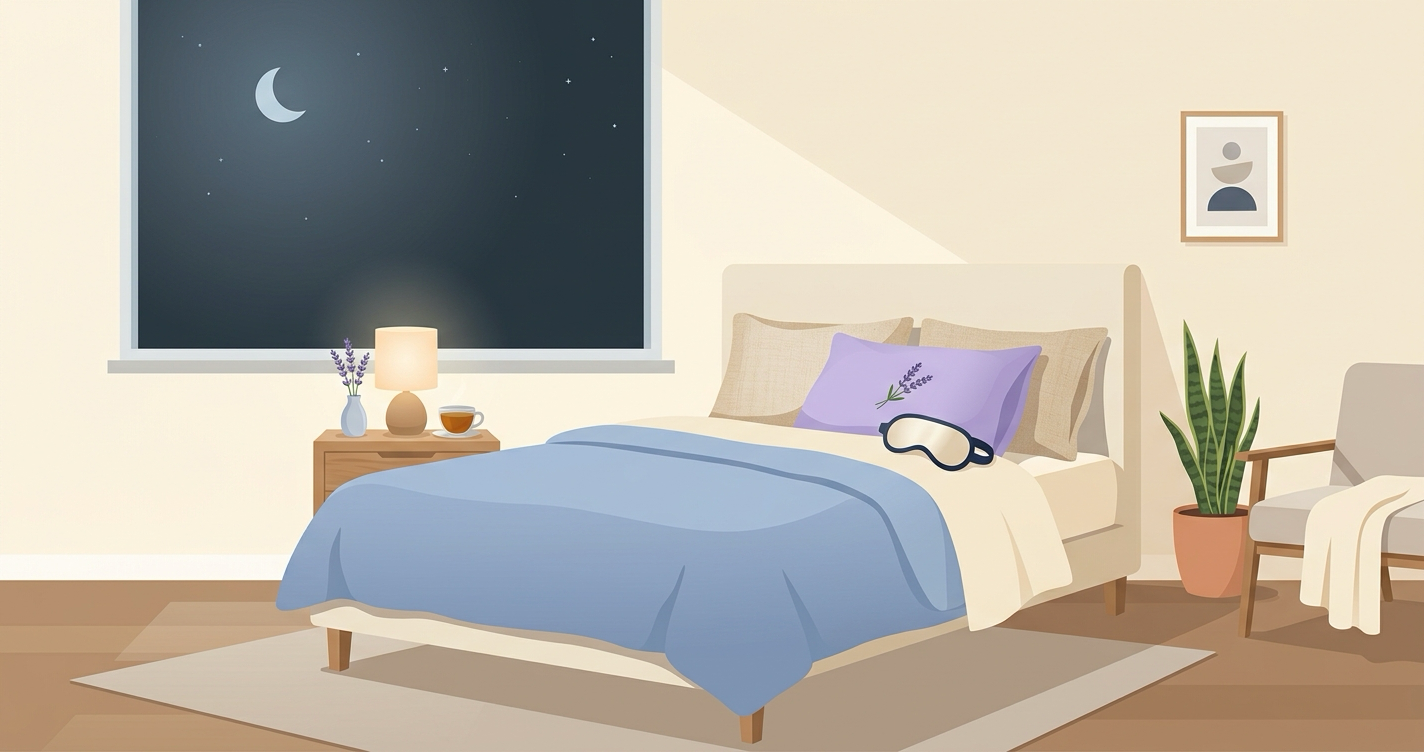
Here’s what happened — in 2021 and 2022, my sleep was genuinely bad. I’m talking 2 or 3am bedtimes, sleeping until 9am, dragging through the first half of every day on coffee. I wasn’t staying up doing anything exciting either. I’d just fall into a scroll spiral or keep a show running, and suddenly it was 2:45am. I told myself I was a night person and that was just how I was built.
I think I was wrong about that. In 2023 I intentionally reset my schedule — set an 11pm bedtime rule, got serious about it, actually followed through. Now I’m roughly asleep by 11:30pm and up around 7am. Not perfect, but the productivity difference was immediate and real. Here are the 15 changes that made the biggest difference — based on actual sleep research, not guesswork.
Why Your Sleep Is Broken (The Short Version)
Your body runs two systems to control sleep. Understanding them helped me stop fighting my own biology.
Circadian rhythm: Your 24-hour internal clock, set primarily by light. It tells your brain when to produce melatonin (sleepiness hormone) and when to stop.
Sleep pressure (adenosine): A chemical that accumulates the longer you’re awake. After 14–16 hours, it peaks and you feel irresistibly sleepy. Caffeine works by blocking adenosine receptors — it doesn’t reduce the pressure, it just hides it until the caffeine wears off.
Both systems need to be aligned for good sleep. Most problems I had (and most people have) came from disrupting one or both — without realizing it.
Methods That Work Tonight
1. Drop Your Bedroom Temperature to 65–68°F (18–20°C)
Personally, this was the biggest single change I made. Back when my sleep was bad, my bedroom was probably sitting at 72°F or warmer. Once I got it down to around 66°F, I noticed I was falling asleep faster within a few nights.
Your core body temperature needs to drop 2–3°F to initiate sleep. A cool room accelerates that. The National Sleep Foundation puts the optimal at 65°F (18.3°C).
If you can’t control the thermostat, a fan or lighter blankets get you most of the way there.
2. Stop Screens 60 Minutes Before Bed
Blue light from phones, tablets, and laptops suppresses melatonin production by up to 50%, according to a Harvard Medical School study. The effect delays sleep onset by an average of 30 minutes and reduces REM sleep quality.
If you can’t avoid screens: Use Night Shift (iOS), Night Light (Windows), or f.lux. These reduce blue light emission by 60–70%. Better than nothing, but not as effective as no screens.
Replace screens with: Reading a physical book, listening to a podcast or audiobook, gentle stretching, journaling.
The phone stays out of my bedroom entirely now. That one habit alone probably accounts for a third of my improvement.
3. Get Morning Sunlight Within 30 Minutes of Waking
This one seemed too simple to actually work. I thought it was the kind of advice people give when they don’t have real advice. But I tried it anyway — I started taking my morning coffee outside when I wake up around 7am — and I think it made a real difference within about a week.
Morning sunlight delivers 10,000–50,000 lux. Indoor lighting is 200–500 lux. That gap matters for setting your circadian clock. Within the first 30–60 minutes of waking, outdoor light:
- Sets your body clock for the day
- Triggers a cortisol pulse that actually helps you wake up properly
- Programs your melatonin release to begin about 14–16 hours later
Ten minutes on a sunny day, 20–30 minutes when it’s overcast. Austin gets a lot of sun so this is easy for me, but even cloudy-day light is way stronger than indoor light.
4. Cut Caffeine by 2 PM
I learned this the hard way — back in my 2am bedtime era, I was drinking coffee at 4pm without thinking much of it. Then I learned that caffeine has a 5–6 hour half-life. That 4 PM coffee is still half-active in your system at 10 PM. A quarter of it is still there at 2 AM.
A study in the Journal of Clinical Sleep Medicine found that caffeine consumed 6 hours before bed reduced total sleep by 41 minutes. I moved my cutoff to around 1pm to be safe, and the difference in how easily I fall asleep was real and immediate.
5. Use the 10-3-2-1 Rule
A simple framework that stacks multiple sleep habits:
- 10 hours before bed: No more caffeine
- 3 hours before bed: No more food or alcohol
- 2 hours before bed: No more work
- 1 hour before bed: No more screens
For a midnight bedtime: stop caffeine at 2 PM, finish eating by 9 PM, close the laptop at 10 PM, put the phone away at 11 PM.
6. Keep Your Bedroom Pitch Black
Even small amounts of light — a charging LED, streetlight seeping through curtains, a clock display — can disrupt melatonin production. Research published in PNAS found that sleeping with even moderate ambient light (100 lux, comparable to a dim room) increased heart rate, reduced deep sleep, and impaired glucose metabolism.
Solutions:
- Blackout curtains ($20–40 on Amazon)
- Cover or unplug any light-emitting devices
- Use a sleep mask if curtains aren’t an option
- Put your phone face-down or in another room
7. Exercise — But Time It Right
Regular exercise improves sleep quality by 65%, according to a meta-analysis in the British Journal of Sports Medicine. It reduces the time to fall asleep and increases deep sleep duration.
Timing matters: Finish vigorous exercise at least 3 hours before bed. Exercise raises core body temperature for 4–5 hours, which opposes the cooling your body needs to sleep.
Best time to exercise for sleep: Morning or early afternoon. Morning exercise in natural sunlight gives you a double benefit (exercise + light exposure).
Exception: Light yoga, stretching, or walking within 1–2 hours of bed is fine and may actually help by promoting relaxation.
8. Stop Eating 3 Hours Before Bed
Late meals force your digestive system to work when it should be winding down. A study in the British Journal of Nutrition found that eating within 3 hours of bedtime increased nighttime awakenings and reduced sleep efficiency.
Specific foods that worsen sleep:
- Spicy food: Raises core temperature and can cause acid reflux
- High-sugar food: Causes blood sugar spikes and crashes that wake you up
- Large, heavy meals: Divert blood flow to digestion
- Alcohol: Though it makes you drowsy initially, it fragments sleep in the second half of the night and suppresses REM
9. Same Wake Time Every Day (Including Weekends)
Honestly, this was the hardest one for me. Before my 2023 reset, weekends were for sleeping until whenever — I figured I was just catching up on the week. But the research is clear and the experience confirmed it — inconsistent sleep schedules wreck your circadian rhythm.
I committed to waking up within 30 minutes of my weekday time on weekends too. The first few weekends were rough. By week three, I was waking up naturally at the same time without an alarm. That alone felt like a superpower.
10. Try the Military Sleep Method
Developed to help soldiers fall asleep in combat zones, this technique reportedly works for 96% of people after 6 weeks of practice:
- Relax your entire face — forehead, eyes, cheeks, jaw, tongue
- Drop your shoulders as low as they’ll go. Relax one arm, then the other.
- Exhale and relax your chest
- Relax your legs — thighs, calves, feet
- Clear your mind for 10 seconds by imagining one of these: lying in a canoe on a calm lake, lying in a black velvet hammock in a dark room, or repeating “don’t think” for 10 seconds
11. Use the 4-7-8 Breathing Technique
Developed by Dr. Andrew Weil, this activates your parasympathetic nervous system (the “rest and digest” mode):
- Inhale through your nose for 4 seconds
- Hold for 7 seconds
- Exhale slowly through your mouth for 8 seconds
- Repeat 4 cycles
This technique reduces heart rate and blood pressure within minutes. It’s particularly effective for anxiety-driven insomnia.
12. Write Down What’s On Your Mind Before Bed
My brain would activate the moment I lay down — back in 2021 and 2022 this was constant. Every unfinished task, every conversation I needed to have, every worry I’d been avoiding all day — suddenly urgent at 11 PM.
A Baylor University study found that spending 5 minutes writing a to-do list before bed helped people fall asleep 9 minutes faster. That doesn’t sound like much, but compounded over months it’s significant — and 9 minutes was the average, not the max.
I keep a notepad on my nightstand now. Five minutes, brain dump everything. It doesn’t have to be organized. Just getting it out of my head and onto paper gives my brain permission to stop cycling through it.
13. Reserve Your Bed for Sleep Only
This principle, called stimulus control therapy, is a core technique in cognitive behavioral therapy for insomnia (CBT-I), the gold standard treatment for chronic insomnia.
Rules:
- Don’t work in bed
- Don’t watch TV in bed
- Don’t scroll your phone in bed
- Don’t eat in bed
- If you can’t sleep after 20 minutes, get up and do something boring in dim light until you feel sleepy, then return
Over time, your brain will associate the bed exclusively with sleep, making it easier to fall asleep quickly.
14. Use White Noise or Pink Noise
Consistent background noise masks disruptive sounds (traffic, neighbors, snoring partners) and creates a stable auditory environment. A study in Frontiers in Human Neuroscience found that pink noise (slightly deeper than white noise) improved deep sleep by 23% and memory consolidation by 26%.
Options: A dedicated white noise machine ($20–40), a fan, or a phone app (set it to play all night, not on a timer).
15. Take Magnesium Glycinate
Magnesium is involved in over 300 enzymatic processes, including those that regulate sleep. An estimated 50% of Americans are magnesium deficient. Magnesium glycinate is the form best absorbed and least likely to cause digestive issues.
Dosage: 200–400mg taken 30–60 minutes before bed. Research in the Journal of Research in Medical Sciences found that magnesium supplementation significantly improved sleep quality, sleep time, and melatonin levels in elderly subjects.
I take 400mg magnesium glycinate most nights — it’s been part of my routine since early 2023 when I did my full sleep reset. I think it helps, though it’s hard to separate from everything else I changed at once.
Note: Consult a doctor before starting any supplement, especially if you take medications.
Things I Tried That Didn’t Help
A few things I wasted time on — sharing because I genuinely wish someone had told me sooner:
- High-dose melatonin: I took 5mg pills for weeks and wondered why they stopped working. Melatonin is a timing signal, not a sedative. 0.3–0.5mg is the effective dose. The 5–10mg products most stores sell are way too much.
- Alcohol to fall asleep: It worked short-term. But alcohol suppresses REM sleep by up to 20% and causes fragmentary waking around 3–4 AM when your body finishes metabolizing it. I was technically unconscious longer but sleeping worse.
- Sleeping in on weekends to “catch up”: Social jetlag is real. This kept resetting my rhythm weekly. I did this for two years and it was actively making things worse.
Where I’d Start If I Were Starting Over
Just three changes tonight:
- Cool the room to around 66°F or as close as you can manage
- Phone in another room 30 minutes before bed
- Try the 4-7-8 breathing when you lie down
These three alone made my first good night noticeable. The others compounded over weeks. You don’t need to implement 15 things at once — start with these and build from there.
Questions I Had
How many hours of sleep do I actually need?
Adults aged 18–64 need 7–9 hours per night. The often-cited “8 hours” is the midpoint. Some people genuinely function well on 7 hours; others need 9. The test: if you need an alarm to wake up and feel drowsy by mid-afternoon, you’re not getting enough. Less than 1% of the population has the genetic variant (DEC2) that allows them to thrive on less than 6 hours.
Why do I wake up at 3 AM every night?
Common causes: blood sugar drops from eating too close to bed, cortisol spikes from stress, alcohol metabolism (alcohol is typically metabolized 3–4 hours after consumption, causing a stimulant rebound), or a room that’s too warm. Try eating earlier, cutting alcohol, and lowering your bedroom temperature.
Is it bad to sleep with the TV on?
Yes. The flickering light disrupts melatonin production, the audio stimulation prevents deep sleep stages, and the blue light from the screen affects circadian rhythm. If you need background noise, switch to an audio-only source like white noise or a sleep podcast.
Do naps help or hurt nighttime sleep?
Short naps (10–20 minutes) before 2 PM help without affecting nighttime sleep. Naps longer than 30 minutes or taken after 3 PM can reduce sleep pressure and make it harder to fall asleep at night. If you’re struggling with nighttime sleep, cut naps entirely until your sleep schedule stabilizes.
How long does it take to fix a broken sleep schedule?
Most people can reset their circadian rhythm in 7–14 days with consistent wake times and morning light exposure. The key is fixing your wake time first — go to bed when you’re tired, but wake up at the same time regardless. Your body will naturally adjust bedtime within 1–2 weeks. My reset took about three weeks before it felt truly locked in, but I was pretty far gone.